DigiByte Wallet for Android
⚠ EARLY BETA
- Only move small amounts of DGB you can afford to lose.
- DigiAsset send/receive works — still treat assets like DGB: only move amounts you can afford to lose during beta.
- Send/receive tested on mainnet with multiple confirmed transactions.
- Back up your recovery phrase on paper before using.
- Do NOT use as your primary wallet.
- Report bugs at GitHub Issues.
🔒 Why We Built It This Way — Your Privacy
Most wallets quietly tell a server exactly which addresses are yours. Here is what each kind of wallet reveals the moment you check your balance:
| Wallet type | What a server or third party can see |
|---|---|
| Web / custodial | Everything — they hold your keys and see your full balance, history, and IP. |
| Multi-coin (Coinomi, Cake, …) | Their servers see your full set of addresses and your IP address. |
| Electrum-style (SPV) | The server learns your entire address fingerprint. Tor hides only your IP from that server — it still knows which coins are yours. |
| This wallet compact block filters + Dandelion++ + Tor | Your address fingerprint never leaves your device. Your phone downloads compact filters and decides locally what is relevant — the node serves you blocks without ever learning which addresses you are watching. |
That is the difference. With compact block filters, the node is never told what you own. Dandelion++ obscures which node your transactions came from, and Tor hides your network location. You watch the chain — without the chain watching you.
What's New in v3.7.5
- Your Wallet Resumes at the Chain Tip Instantly (v3.7.5) — Some wallets re-downloaded hundreds of thousands of block headers on every launch — showing “Connected” while silently catching up underneath, so recent payments displayed the wrong number of confirmations (or none). Two causes, both fixed: on startup several parts of the app race to start the network engine, and the fastest one could build it before the saved chain finished loading — starting over from a months-old checkpoint; and a leftover one-time “rescan” reset the chain back to that checkpoint right after it had caught up. The wallet now waits for the saved chain before connecting, and skips that rescan for wallets that have synced before — so it resumes exactly where it left off, in seconds, with correct confirmations. Verified on a Note 8 across repeated restarts. Your funds were never affected; this was always about how quickly the wallet caught up and displayed confirmations.
- Interrupted Sends Recover Themselves (v3.7.5) — If your phone killed the app in the few seconds after you tapped Send (aggressive battery management, force-stop, low memory), a transaction could be recorded on your device but never actually delivered to the network — stuck “unconfirmed” forever, with the recipient never seeing it. The wallet now re-broadcasts any such send the moment it next connects, retrying until the network relays it back and confirming it actually propagated. A send stranded this way during testing was automatically recovered and confirmed on-chain on the next launch. It also detects the rare case where a stuck send can never confirm and clears it, so your balance corrects itself.
- Honest Sync Progress (v3.7.5) — On the rare occasion the wallet is genuinely behind the network, it now shows real catch-up progress instead of displaying “Connected” while quietly working in the background — so you always see its true state.
- More Reliable Sends by Default (v3.7.5) — Two privacy features are now off by default while we finish hardening them: Dandelion++ (which delays a transaction’s first network hop for sender privacy) and in-app Tor. With both off, sends broadcast directly for the most reliable delivery. Both remain available as opt-in toggles under Settings → Network Info. Your address privacy is still protected by compact block filters; for IP privacy we continue to recommend Orbot or a system VPN.
- Confirmations No Longer Lag Behind the Network (v3.7.4) — Some wallets could sit “Connected” yet quietly far behind the chain tip — recent payments showing as unconfirmed or stuck at one confirmation even though the network had long since confirmed them. The root cause was in how the wallet remembers its sync progress between launches: it saved only a small recent window of blocks, on a timer, with no flush when the app closed and no guard against going backwards — so a session killed mid-catch-up could overwrite a newer saved position with an older one, forcing a ~480,000-block (~26-minute) re-sync on the next launch, every launch. Three fixes: the saved position can now only ever move forward (never overwritten with an older one), the wallet flushes its latest position the moment it’s closed, and the bundled bootstrap checkpoints are refreshed so brand-new installs start near the tip instead of re-scanning ~83 days of history. Verified on a Note 8: the wallet now resumes at its saved tip instantly across restarts. Your funds were never affected — balances are computed from the chain itself; this was purely about how quickly the wallet caught up and displayed confirmations.
- No More Freeze While Sending (v3.7.3) — Sending a payment could briefly freeze the screen — long enough on some devices to trigger Android’s “app isn’t responding” dialog. The wallet’s background status poll was reading network state on the main (UI) thread, so while a send held the networking lock the UI could stall behind it. The poll now runs entirely off the main thread, matching how the rest of the app already worked. The transaction itself was always broadcast correctly — this only affected the screen responsiveness around it.
- Correct Sent Amounts in Activity (v3.7.2) — A sent payment could display a smaller number in the activity list than you actually sent (while your balance dropped by the correct full amount). When the wallet hadn’t fully loaded the parent transactions behind a send, its core under-counted the outgoing amount. The wallet already records what you actually sent at broadcast time, and now uses that recorded amount for any payment it sent, so the displayed figure always matches reality.
- Always-Ready Connections on the Main Screen (v3.7.2) — While you’re actively on the wallet screen, the app now gently re-establishes peer connections the moment they drop to zero, instead of waiting on the slower background cycle — so a send or receive isn’t left waiting on a cold connection. Battery-safe: it only does this while you’re actually looking at the screen, and only when fully disconnected.
- Crash-on-Open Fixed on the Newest Phones (v3.7.1) — A small number of Android 15 devices (e.g. Galaxy S25 Ultra) that had been left disconnected could crash immediately on opening the wallet. A reconnection path added the previous release could free and rebuild the networking engine while other threads were still reading it — a classic use-after-free. Every entry point into that engine is now serialised behind a lock, so the rebuild can’t race a reader. Stress-tested 30 reconnect cycles on an S25 Ultra with zero crashes; no funds were ever at risk.
- Transaction-Origin Privacy: Dandelion++ (v3.7.0) — New outgoing transactions are now relayed using Dandelion++: instead of broadcasting to all peers at once (which can reveal which node a payment originated from), the wallet first passes the transaction quietly to a single capable peer for a short, randomised delay before the network spreads it widely. This makes it much harder for a network observer to link a transaction back to your phone. Combined with compact block filters (which keep your addresses private), this closes the other side of the privacy picture — transaction origin. Verified end-to-end on a Note 8.
- Security: Hardened Against a Malicious-Peer Crash — A peer on the network could send a malformed, oversized message that made the wallet’s networking code overflow its stack and crash — a remotely-triggerable denial-of-service. It’s now fixed by allocating large network messages safely instead of on the limited thread stack. Found and verified by reproducing and symbolicating the exact crash on a Galaxy S25 Ultra; no user funds were ever at risk, but a crash-loop could have prevented syncing.
- Both Filter Modes On by Default — New wallets now sync using both compact block filters (private — your addresses never leave your device; the peer can’t learn which addresses you watch) and bloom filters in parallel, with compact filters preferred. This gives the best coverage and reliability while the network of filter-serving nodes continues to grow.
- Fewer False Warnings — Two startup banners that could appear incorrectly are fixed. “Balance refresh failed” no longer shows on a brand-new wallet (there’s nothing to reconcile, so it was a false alarm that even came back after dismissing it). And the “Tor unavailable” notice now clears the moment Tor reconnects, instead of staying stuck on screen for the rest of the session.
- Tor Is Now Off by Default (Temporarily) — An honest update that corrects last release’s note: while testing the in-app Tor integration end-to-end, we found its peer routing isn’t actually working yet — connections don’t complete through it, so the wallet was quietly falling back to direct connections every session. Rather than imply a privacy protection that isn’t in effect, Tor is now off by default. Your address privacy is still protected by compact block filters, and transaction-origin privacy is coming with Dandelion++. To hide your IP address today, the most robust approach on Android is to run the wallet through Orbot or a VPN at the system level. In-app Tor remains an opt-in toggle in Settings → Network Info while we fix or replace the integration.
- Tor Routing Fixed on the Newest Phones — The previous build’s 16 KB page-size change had an unintended side effect: it broke Tor (private routing) on devices where it was enabled. Tor was previously run as a separate background program, which requires the app to unpack its files to disk at install — but the same 16 KB packaging that fixes the newest phones stops that unpacking, so Tor couldn’t find its files and failed to start. The wallet now runs Tor in-process (loaded directly, no unpacking needed), which works alongside the 16 KB packaging and is also more reliable on Android 15/16, where the system increasingly restricts running separate programs from an app’s data folder. Verified on a Galaxy S25 Ultra (Android 16): Tor bootstraps, connects, and routes the wallet’s traffic with privacy intact. If you don’t use Tor, nothing changes for you.
- Invalid Recovery Phrases Are Now Caught Immediately — A user restored a wallet on a new phone and it would never connect — stuck on “Connecting…” with a $0.00 balance forever. The cause was a mistyped recovery phrase. The restore screen checked that every word was a real BIP39 word, but it didn’t verify the phrase’s built-in checksum (the last word mathematically validates the rest). So a phrase with a typo — where the wrong word still happened to be a valid word — was accepted, but the wallet could never actually be built from it, and the sync engine quietly gave up with no explanation. The wallet now validates the full checksum the moment you enter your phrase and tells you right away if it isn’t valid, so you can fix the typo instead of ending up with a wallet that silently never works. Your funds are always safe on the blockchain — this only affected entering the phrase on a new device.
- 16 KB Page-Size Support (Newest Phones) — The latest flagship phones (Android 15+, e.g. the Galaxy S25 series) are moving to a 16 KB memory page size instead of the long-standing 4 KB. Apps whose native code isn’t aligned for 16 KB pages can fail to load that code — which, for this wallet, meant the sync engine couldn’t start on those devices. The app’s native libraries are now built and packaged 16 KB-aligned (uncompressed and page-aligned inside the APK), so the wallet runs correctly on both 4 KB and 16 KB devices. This also keeps the app compliant with the upcoming Google Play requirement. One trade-off: storing the native code uncompressed makes the direct-download APK larger, which is why this build is a bigger file than the last.
- Long-History Wallets Now Show Their Latest Transactions — A legacy user with a long transaction history restored their wallet, saw the correct balance and all their old transactions, then sent a few new payments — the balance updated, but the new sends never appeared in the activity list. The cause: the activity list was capped at a fixed number of transactions, and it was keeping the oldest ones instead of the most recent (the wallet core hands transactions back oldest-first, and the cap was reading from the wrong end). Balances were always correct — the total is computed across every transaction — so no funds were ever affected; it was purely a display bug that only surfaced on wallets with a large history. The list now keeps the 100 most recent transactions, always newest-on-top, with pending sends pinned to the very top until they confirm. If you were affected, your new transactions reappear as soon as you update and re-sync.
- Private Sync Survives a Reboot — A real bug: on some devices, after a phone restart the wallet would show “Privacy degraded for this session” and fall back to bloom — every single launch, never recovering. Root cause: the compact-filter header chain is saved to disk between runs, and on these devices it occasionally restored in a state that every honest filter peer disagreed with. The old code treated each disagreeing peer as misbehaving and disconnected it, so the wallet burned its whole pool of private-filter peers and dropped to bloom. Now the wallet recognises the opposite — when the majority of peers reject its saved chain, it is the outlier, not them. On the first disagreement it immediately polls the other filter peers to confirm, and once two independent peers agree it discards the bad chain and re-syncs the recent filter headers from scratch. Verified on a Note 8: a chain that used to fall to bloom on every reboot now self-corrects in well under a second and finishes syncing on private compact filters — no fallback, no banner. A follow-up launch with the now-healthy saved chain comes up private in about 15 seconds.
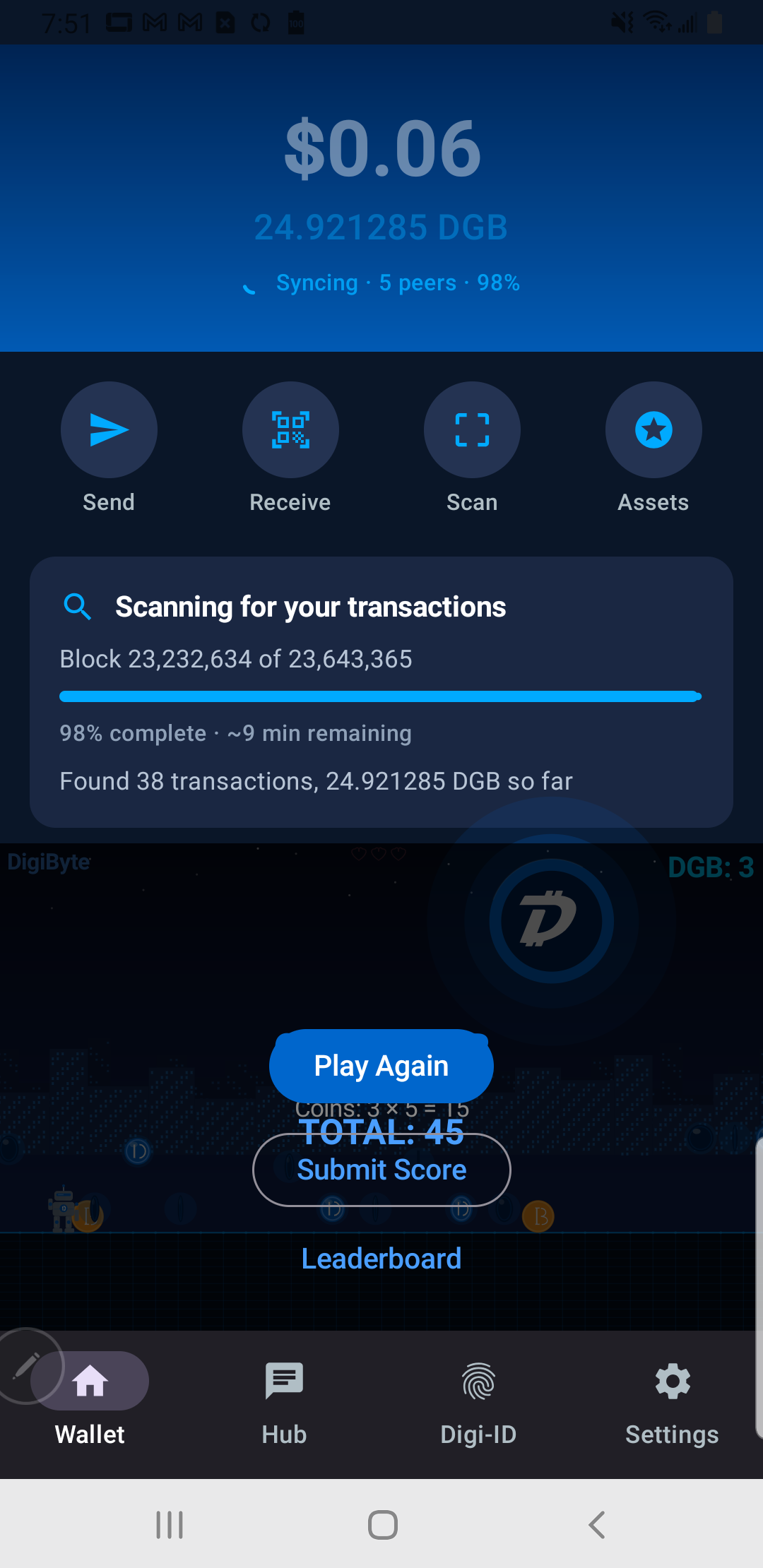
- Honest Sync Progress — The “Block X of Y” readout and percentage on the sync screen could sit frozen at the network tip showing a stuck “100%” while the wallet was actually still scanning hundreds of thousands of blocks underneath — it looked locked up even though it was working fine. The displayed current-block height was being clamped up to the estimated network tip, which also flat-lined the time-remaining estimate. Now the wallet shows the true block it has reached, so the number climbs steadily, the percentage reflects real progress, and the ETA moves — sync no longer looks hung while it’s catching up.
- Smarter Privacy Fallback — A brief connectivity hiccup no longer drops you to bloom for the whole session. When block-header sync stalls (a peer dropping mid-download), the wallet briefly uses bloom to keep the chain moving, then automatically switches back to private compact-filter sync once it catches up — silently, no banner. The “Privacy degraded for this session” notice now appears only when compact filters are genuinely unavailable, with clearer wording.
- Wallet Won’t Get Stuck at “Connecting…” Anymore — The keepalive loop has been re-feeding the wallet fresh peers from the seeder every 10 seconds for as long as anyone can remember, but on devices where the initial peer set failed (a stuck Tor circuit, an aggressive router, a temporary outage) those re-injections went straight to a hold queue that’s only consulted once at startup — the live peer manager never saw them. The wallet would sit at “Connecting…” or 0 peers for hours or days even though the user’s phone could reach DigiByte nodes fine on the network. Fixed by a new
BRPeerManagerAddPeerbridge in the C core that pushes injected peers straight into the live candidate pool; on first launch with this build, a Note 8 that had been at 0 peers for 15+ minutes was Connected with 5 peers within 60 seconds. The change made the whole sovereignty stack feel real on slow networks. - Tor Unavailable Banner — If Tor is enabled but the bootstrap takes longer than two minutes to deliver a working SOCKS5 circuit, the wallet now visibly tells you so and degrades to direct connections for the session rather than sitting silently at 0 peers. Sister banner to the existing “Privacy degraded for this session” BIP158-to-bloom fallback notice; same lifecycle — next app launch retries Tor before degrading. Also closes a path where a stale
Startingstate from a previous run could block every subsequentstart()call indefinitely. - Force-Stop Resilience for In-Flight Sends — If you sent a transaction and your phone aggressively killed the app moments later — Samsung/Xiaomi battery management, force-stop, low-RAM reaping — the wallet could come back on next launch showing a balance dropped by the full input value rather than just the send amount. Root cause: the change address from the in-flight send sat outside the address window pre-generated when the wallet bulk-loaded its saved transactions, so when the peer eventually relayed the tx back, the local wallet silently rejected it. Three coordinated fixes: the native publish path registers each outgoing tx into the wallet’s internal set before broadcast (so the wallet holds a copy the instant Send returns, idempotent against the peer relay-back that lands later), a new WalletTxPersister snapshots that state to disk synchronously via fsync immediately after broadcast, and the wallet now watches 100 extra addresses past the standard gap limit on load — matching the look-ahead the wallet already used for the bloom filter advertised to peers. Local watch-set and peer filter now stay coherent across the broadcast → restart boundary even under hostile process lifecycles.
- Block Filters Are Now the Default Sync Mode — The wallet now syncs the chain using BIP 157/158 compact block filters by default. Unlike bloom filters (which the wallet historically used, and most SPV wallets still do), compact filters never tell peers what addresses your wallet is watching. The peer sends you a small encoded filter for each block, the wallet checks every filter locally, and only requests the full block when there’s a hit. Your address set stays on your phone. A pool of opt-in DigiByte full nodes serves these filters — we crawl for filter-capable peers, deliver them through our seeder API, and route through them automatically; bloom mode remains available in Settings → Sync Mode for users who prefer maximum peer compatibility.
- Graceful Bloom Fallback — Filter-serving peers are a smaller pool than bloom-serving peers right now. If the wallet can’t make filter progress within 120 seconds (Tor circuit failures, all filter peers down, transient outage), it automatically falls back to bloom for the rest of the session and surfaces an amber “Privacy degraded for this session” banner on the wallet home so you know what happened. Next app launch tries filters first again, so a brief outage doesn’t permanently downgrade your privacy. No silent privacy loss, no permanent hang on connection problems.
- Block-Filter Decoder + Wire Driver Fixes — Three bugs in the C core’s BIP 158 implementation prevented end-to-end filter sync from working against real peers. The GCS decoder rejected every honest filter due to a strict end-of-stream check that didn’t accept BIP 158’s mandatory byte-alignment padding (
bytePos < lenflagged trailing padding bits as excess data). The cfheaders driver only fired at peer-connect time, so on a fresh boot where the checkpoint height was below the auto-fetch start, it bailed once and never re-tried after headers caught up. And lazy chain initialisation hardcodedstartHeight=0, anchor=ZEROinstead of anchoring at the configured wallet birth height with the peer’s claimed previous filter header. Verified end-to-end against a live filter peer: cfheaders requested, chain extended, cfilter MATCH on the exact block containing a real test payment, full block downloaded. - DigiAsset Send Is Live — The Send button on the asset detail screen now actually sends. Enter a recipient DigiByte address and a quantity (respecting the asset’s divisibility — too-precise input is rejected rather than silently truncated), tap Review & Send, confirm. The UI shows a spinner during broadcast, auto-dismisses the dialog on result, then a banner at the top of the screen displays either the transaction id on success or a specific error on failure. End-to-end wiring across the encoder, coin selector, native build & sign JNI, and publishTransaction that have been landing in previous releases.
- Doze-Frozen Keepalive Fix — The peer-keepalive respawn we shipped in v3.5.20 only fired when the Job was cancelled. In practice an overnight Android Doze pause can freeze a coroutine inside
delay()without cancelling it — Job reports active, respawn never fires, peers stay at 0. Fix: the keepalive stamps a tick watermark every 10 seconds; if onStartCommand observes a stale watermark (>60s since last tick) it force-cancels and relaunches. Observed live on the emulator: 7-hour Doze pause would previously have required the user to force-stop the app. - Assets Empty State Points to digiscope.me Issuance — When a user opens the Assets tab with no DigiAssets, there’s now a prominent callout linking to
digiscope.me/assets/create. With the two public DigiAsset issuance tools (digiassetX.com, diginexum.trade) currently offline, asset creation is being brought online on our own infrastructure so users aren’t blocked. The wallet stays intentionally out of issuance — that’s a web concern with account auth, IPFS pinning, and user-deposit handling that belongs server-side. - DigiAsset Send Engine Under the Hood — The next layer of DigiAsset send lands: a new native bridge
buildAndSignAssetTransferTxthat assembles a full DigiAsset transfer from pre-selected UTXOs and pre-constructed outputs (recipient 700-sat marker, OP_RETURN with the transfer payload, DGB change), signs with the wallet’s own BIP84 keys, and returns signed tx hex. AssetManager.sendAsset() is no longer a stub — it ties the coin selector, the transfer encoder, native signing, and broadcast into one cohesive flow with typed error results for every failure mode. The send button UI still shows “Coming soon” — final UX wiring (input validation, confirmation dialog, broadcast progress) lands next release so each layer stays testable in isolation rather than being entangled with the UI. - DigiAsset Send Foundation (Encoder + Coin Selector) — Pure-logic prerequisites for sending DigiAssets land in this release, with rock-solid test coverage including byte-exact matches against real on-chain mainnet DigiAsset transactions. The BitWriter (inverse of the existing BitReader) handles MSB-first bit packing and SFFC fixed-precision amount encoding. The DigiAssetEncoder assembles TRANSFER opcode payloads — verified to produce identical bytes to a real block-11,000,208 mainnet transaction, and the other gold fixtures from the decoder test suite. The AssetCoinSelector picks minimal input sets for a transfer: asset UTXOs summing to the send quantity, plus only the DGB UTXOs needed to cover the per-recipient marker outputs and network fee, correctly accounting for the 700-sat marker value that asset inputs contribute. No user-facing asset send button yet — the remaining native transaction-building JNI and UI wiring ship in follow-up releases, intentionally staged so each correctness layer is verifiable in isolation.
- Multi-Endpoint DigiAsset Data Layer — The wallet now resolves DigiAsset metadata through a sovereignty-first multi-endpoint client: it tries
digiscope.me(our own cert-pinned proxy to a locally-hosteddigiasset_coreinstance), then falls through toapi.digiassets.net/v3(the official endpoint maintained by the DigiByte Core team), with a per-endpoint circuit breaker borrowed from RenzoDD’sdigibyte-jspattern — three consecutive failures open the circuit for 60 seconds, any success resets it. Reduces single-point dependency and means asset icons and metadata still load even when public IPFS gateways are slow or unreachable. Backend gains six read-only proxy routes (/api/assets/*) passing through to digiasset_core over loopback Basic auth, protected from accidental deploy-strip by a prominent comment block. Future releases will add user-configurable endpoints for full sovereignty. - Per-Asset Transaction History — Opening an asset’s detail screen now shows only that asset’s transactions instead of the full asset-activity firehose across every DigiAsset you hold. Under the hood the transactions table gains a nullable
assetIdcolumn (Room schema v5); a one-shot backfill worker runs on first launch after the upgrade and populates it two ways: a fast SQL join against the UTXO table (already carries asset_id per row), then a Kotlin fallback that decodes the raw OP_RETURN for any asset-tx rows whose UTXOs were already spent and pruned. SharedPreferences flag blocks re-runs, a Mutex serialises concurrent SyncService restarts, and a no-progress guard prevents infinite loops on undecodable edge rows. Also fixes a latent bug where the detail screen’s history viewmodel snapshot-read the selected asset ID once at construction (always null) and never updated — history now re-collects reactively when you navigate between assets. - DigiAsset Images Now Render — The Assets list and asset-detail screens previously showed a colored letter circle for every DigiAsset regardless of whether the asset had a real icon on IPFS. Wallet now loads the actual image via Coil, routing
ipfs://URIs through the existing multi-gateway hash-verifying IpfsClient (so a malicious gateway returning the wrong bytes is caught at the CID-multihash layer, not silently rendered). HTTPS-hosted asset images reuse the Tor-aware app-wide OkHttp client. The letter fallback stays beneath the image slot — on any load failure (unreachable gateway, verification mismatch, no metadata) the letter remains visible so the UI never breaks. Also handles all four wild-west imageUrl shapes we see in the field: full HTTPS URLs,ipfs://<cid>,/ipfs/<cid>, and bare CIDv0/v1. - Synced-State Grace Window — Headers can reach the chain tip while the per-block merkleblocks matching the wallet’s bloom filter are still being delivered. The sync loop was flipping the UI to “Connected” the instant header height caught up, freezing users on a stale balance (they’d see a previous balance that didn’t yet reflect a spend whose block hadn’t been scanned). The service now requires 30 seconds of stable at-tip observation before flipping to Complete. If a new block arrives and the wallet falls behind mid-grace, the counter resets cleanly. Prevents “wallet says I’m synced but my balance is wrong” without impacting steady-state sync time.
- Scan for Missing Funds Now Prunes Stale UTXOs — The reconciliation backend had always returned every tx that ever touched the wallet’s addresses (via the ElectrumX scripthash history), but the Android client was only feeding the parents of currently-unspent outputs into the native tx processor. That meant Scan for Missing Funds fixed “missing receives” but couldn’t fix “balance too high because SPV missed the block that contained your spend”. The client now passes every returned tx through
BRWalletRegisterTransaction, so spending txs properly debit consumed inputs. Scan is now symmetric — corrects both directions of SPV data loss. - Stable Sync Progress Percent — The sync-progress percent is now anchored to the authoritative chain tip from the digiscope.me full node (new
/api/chain/tipendpoint, 5-second cached). Previously the denominator was SPV’s peer-negotiatedestimated_heightwhich churns every time a new peer arrives with a different tip claim, causing the percent to jump back and forth (“40% → 99% → 60% → 99%”) during early sync. Honest math, confusing UX. Now: the wallet fetches the real tip every 30 seconds, takes the max against the peer-quorum value, and uses it for both the percent and the “Block X of Y” readout. On network failure the stored tip is left unchanged so a momentary blip doesn’t regress the denominator to zero. Users see a monotonically climbing number. - Keepalive Resurrection — Fixed the “wallet stuck at 0 peers forever” state that could still bite after extended idle even with the v3.5.13 UI watchdog. Root cause: the watchdog’s startForegroundService kick deduplicates into the already-running service, and the service’s early-return guard on repeat
onStartCommandwas skipping keepalive setup. If the original keepalive coroutine had died silently (Doze, an unhandled JNI throwable, etc), the service stayed nominally alive with its foreground notification while no one was reconnecting peers — watchdog kicks all arrived as no-ops. The keepalive is now tracked as a Job and respawned on every onStartCommand that sees it inactive. Observed in the wild after 20 hours idle, 827 fruitless watchdog kicks. - PIN-Confirm ANR Fixes — Three separate JNI/Keystore call paths were landing on the main thread during wallet creation and recovery, and on returning to the app after sockets had dropped. Moved
clearPin(Keystore-backed) into the worker dispatcher, and movedstartSync(opens BRPeerManager sockets, can block for seconds) off Main in both the post-PIN success callback andMainActivity.onResume’s defensive reconnect. Removes the Android “Wait / Close” dialogs that have been interrupting onboarding on slower hardware and emulators. - Sync-Progress UI Dedup — The wallet was showing two separate sync percentages (one in the header, one in the body) reading from flows that updated on different ticks — they visibly bounced against each other (“40% ↔ 99%”) as peer chain-tip estimates churned mid-sync. The verbose card in the body is now the single source of the percentage; the header shows connectivity state plus peer count plus block height with no percent. The DigiRunner mini-game overlay no longer renders its own third progress bar either. One number, one place.
- Keyboard-Safe Seed Entry — The seed-phrase entry grid now actively scrolls the focused field into view when the soft keyboard appears.
imePaddingalone reserves space at the bottom but leaves lower-row fields hidden behind the keyboard; the newBringIntoViewRequesterattached to each field ensures whichever one you tap scrolls up above the keyboard before you start typing. - Faster Address Format Toggle — Receive screen pre-derives both the legacy (D...) and bech32 (dgb1q...) addresses once on first composition, so switching the format chip no longer re-runs the JNI key-derivation path on every tap. Instant toggle, zero work per click.
- Lifecycle-Aware State Collection — Swept 14 call sites across eight screens from
collectAsState()tocollectAsStateWithLifecycle(): Network Info, Scan for Missing Funds, Security & PIN, Display, Recovery Scan, Recovery Date, Seed Display, and the top-level navigation wallet-state collector. Prevents the ViewModels behind those screens from doing unnecessary work when the wallet is in the background — small battery and memory win on every one of these views, plus future-proofs the screens against regressions where a flow emits rapidly while off-screen. - Seed-Isolation Test Allow-list Refreshed — Internal plumbing: the security test suite that audits the JNI surface for seed-leaking method signatures is now aware of the
mnemonicToSeedandderivePrivateKeyWIFpaths introduced by Universal Restore in v3.5.15. Each allow-list entry carries a one-line rationale so future contributors understand why the narrow exception is safe. No runtime behavior change. - Auto-Reconcile on Upgrade — Every version bump now silently runs the “Scan for missing funds” flow in the background, once, after peers stabilize. Any UTXOs that earlier SPV windows missed — stale bloom peers, cracked filter runs, pre-Universal-Restore BIP84-only scans — are pulled in automatically. You no longer need to know Settings → Recovery exists to recover balance that went missing between releases. The wallet waits 10 seconds after unlock for peer connectivity to settle, then queries the authoritative UTXO set for every address it derives (400+ across all derivation paths) and imports any receives the SPV bloom scan missed. Gated by versionCode so the node is only contacted once per release.
- Keyboard-Safe Text Inputs — Fixed the soft keyboard overlapping the seed-phrase grid on the Recover Wallet screen, and preemptively applied the same fix to the Send, Receive, Asset Send, Scan for Missing Funds, and Hub profile editor screens. Edge-to-edge rendering in newer Compose was short-circuiting the window-level “adjust resize” behavior; each affected screen now declares
imePaddingdirectly so the form shifts up cleanly when the keyboard appears. - Send-Screen Peer State Sync — Fixed a UX bug where tapping Send from the Wallet screen briefly showed a “not connected” banner even when the Wallet and Network screens were already reporting five connected peers at chain tip. Each screen was spinning up its own WalletViewModel with a peer count initialized to zero until its own 5-second poll caught up. The Send, Receive, and Transaction Detail screens now share the Wallet route’s ViewModel — peer count, sync state, balance, and transaction list are live the instant you navigate in.
- Universal Restore — Seed recovery now probes every derivation path DigiByte wallets have historically used: BIP84 native DGB, legacy m/0H with both the “DigiByte seed” and “Bitcoin seed” HMAC seeds, BIP44 DGB, BIP44 wrong-coin (m/44'/0'/0'), and BIP49 P2SH-P2WPKH — all scanned in parallel against the reconcile backend before you pick a recovery date. If any non-native path holds funds, the wallet auto-sweeps them into the new BIP84 wallet after recovery completes, so legacy users who drifted across derivation standards don’t have to hunt for old addresses manually. Gap limits bumped to 200 external / 100 internal per profile to cover heavily used chains. BIP49 funds are surfaced with a “manual recovery needed” hint (automated P2SH-P2WPKH sweep deferred; BRTransactionSign doesn’t yet handle P2SH redeem-script scriptSig).
- Rotating Bloom Peer Pool — The wallet now maintains a growing pool of every bloom-serving peer it has ever been told about, rather than replacing the list on each seeder fetch. Reconnect cycles rotate through the pool so the same flaky 20 peers aren’t hammered for an hour before a re-fetch. The bloom seeder at api.digiscope.me is only contacted when the pool is stale (>1h) or empty — transient seeder outages no longer degrade wallet connectivity.
- Process-Death Watchdog — Fixed the long-standing “wallet stopped syncing after phone was idle” stall. Root cause identified: Android was reaping the entire app process under memory pressure (or aggressive OEM battery management on Samsung / Xiaomi / OPPO), and the sync service never recovered even though the system was supposed to restart it. The UI now runs a 5-second poll that detects sustained zero-peer state and re-launches the sync service directly — the UI process usually survives the reap, so it can act as a second line of defense. Also hardened the notification channel priority and category so OEM killers classify the sync service as a persistent background task instead of a reap candidate.
- Scan for Missing Funds — New Settings → Recovery flow that queries a DigiByte full node for the authoritative UTXO set on every wallet-derived address, then injects any receives the SPV bloom scan missed directly into the wallet. Recovers balances stuck in the “showed up for a second then disappeared” state when peers drop merkleblocks or the native rescan no-ops against stale tips. Defaults to the cert-pinned api.digiscope.me endpoint; advanced users can point it at their own DGB node for full sovereignty — only public addresses are sent, never any keys.
- Stale-Peer Sync Guard — Hardened the
onSyncCompletenative callback against stale peers that report a chain tip below the hardcoded checkpoint floor. Previously a peer announcing an old tip could latch the wallet into the “Synced” state even though the real chain is far ahead; the rescan would then stop and transactions in the unscanned range would never be found. Now both the poll loop and the JNI callback refuse to accept a completion signal below the checkpoint floor and let the bloom scan keep running until a real tip peer appears. - Recovery Year Labels Fixed — The year picker on the seed-restore date screen was off by one (the “2026” option wrote a 2025 timestamp; “2025” wrote a 2024 timestamp; etc). Users selecting their actual wallet creation year were getting scans starting one year too late, silently missing older transactions. Timestamps now match the labels.
- Historical Sends Preserved — Fixed a long-standing issue where old send transactions appeared in history on app launch and then vanished the moment the wallet finished syncing. The mempool-cleanup path that fires at chain tip was removing saved transactions marked as unconfirmed (a byproduct of the transaction-serialization format not persisting block heights). The cleanup now spares any transaction the wallet has a stake in — whether we spent UTXOs producing it or received coins from it — regardless of whether peers are still relaying it. Balance was already correct for affected users; this restores the transaction-history display.
- Peer Connectivity Guardrails — Send and Receive screens now show a clear banner when the wallet has zero connected peers, and the Review & Send button is disabled until connectivity is restored. Prevents the footgun of broadcasting a transaction into a disconnected peer manager where it silently strands locally.
- Defensive Reconnect on Resume — Returning to the app from an extended background now explicitly re-kicks peer connection when peerCount is zero, independent of the 10-second background keepalive. The keepalive itself is also hardened against silent coroutine death. Fixes the “reopen the app, still 0 peers” state users have hit after long sleeps.
- Upgrade Path Restored — From v3.5.9 on, signing lineage (APK Scheme v3) allows existing debug-key installs to update to release-signed builds without uninstalling first.
- In-App Update Notifications — Releases publish as stable so the built-in UpdateChecker surfaces an update dialog when a newer version ships.
- Send Transaction Reliability — Four-stage fix for sent transactions disappearing after sync in dual-key wallets. Saved txs are now bulk-added ahead of sync, parent txs are preserved when hasLegacyKey is set, the forced rescan on BIP84 upgrade is removed, and mempool cleanup is deferred until chain tip. Your send history stays intact across restarts.
- BIP84 Upgrade Path — Crash-free upgrade from v3.4.0. The dual-key wallet registers all addresses (BIP84 + legacy) before processing saved transactions. About screen now correctly labels Wallet Type as “HD Wallet (BIP84)” to match the m/84'/20'/0' path shown below it.
- BIP84 Standard Derivation — Addresses match Ian Coleman's BIP39 tool. Standard “Bitcoin seed” HMAC + m/84'/20'/0' path. Dual-scan recovery finds funds from both new and legacy key trees.
- Bloom Peer Retention — Non-bloom gossip peers filtered from pool. All connection slots go to verified bloom peers. Zero SPV rejections.
- Sync Stall Recovery & Tor — Download peer reassignment every 10s prevents stalls. All traffic routable through Tor SOCKS5 with DNS leak prevention.
What Works
- Full SPV wallet — send, receive, QR scanning (mainnet tested)
- Digi-ID authentication with real cryptographic signing
- One-tap DigiScope login (no QR scan needed)
- Community Hub — chat, forum, Enigma AI bot
- DigiRunner mini-game with cross-platform leaderboard
- Hardware-backed seed encryption (Android Keystore)
- Block & transaction persistence — balance spendable on restart
- PIN lock when app backgrounds
- Bloom peer discovery — 19 peers from network seeder, re-injected on reconnect
- Tor privacy routing — all traffic through SOCKS5, toggle in Settings
Known Limitations
- DigiAsset issuance — created on the web at digiscope.me/assets/create, not in-wallet; detection, send, and receive are supported
- Tor routing — functional with SOCKS5 IPv4/IPv6, DNS leak prevention, dead proxy recovery. On-device DNS leak audit pending.
Node Operators: Enable Bloom Filters
This wallet uses SPV with bloom filters to sync without downloading the full blockchain. Most DigiByte v8.26 nodes have bloom filters disabled by default.
Enable bloom filters on your node to support mobile wallets:
- Open your
digibyte.conf:Linux: ~/.digibyte/digibyte.conf Mac: ~/Library/Application Support/DigiByte/digibyte.conf Windows: %APPDATA%\DigiByte\digibyte.conf
- Add:
peerbloomfilters=1
- Restart your node
Benefits:
- Supports SPV wallets across the network
- Minimal resource impact
- Your node is auto-discovered by the bloom seeder
Trade-offs:
- Slightly increased bandwidth
- Theoretical bloom filter privacy concern — mitigated by planned Tor + Dandelion++ integration
Test Results
| Unit Tests | 120/120 passing |
| Security Tests | 42/42 passing |
| Pre-Publish (API 28) | 6/8 PASS, 2 SKIP |
| Pre-Publish (API 33) | 6/8 PASS, 2 SKIP |
| Pre-Publish (API 34) | 6/8 PASS, 2 SKIP |
| Pre-Publish (API 35) | 6/8 PASS, 2 SKIP |
| Maestro E2E (device) | 3/3 PASS |
| Mainnet Send/Receive | Multiple confirmed |
Roadmap
- ✅ Core wallet (send, receive, sync, security)
- ✅ Digi-ID + DigiScope integration
- ✅ Community Hub (chat, forum, Enigma AI)
- ✅ Security audit + 42-test suite
- ✅ DigiRunner v2 with leaderboard
- ✅ Mainnet send/receive
- ✅ Seed security hardening (CRITICAL-2/3)
- ✅ DGB-native fee structure
- ✅ Bloom peer discovery + seeder
- ✅ Pre-publish test suite (5 API levels)
- ✅ DigiAsset send/receive
- ✅ Tor privacy verification
- 🚧 Dandelion++ SPV (v9.26)
- 🚧 BIP157/158 compact block filters
- 🚧 Third-party security audit
- 🚧 Google Play Store / F-Droid
Built by the DigiByte community. MIT License. Android 8.0+.
Tested on Samsung Galaxy Note 8 (Android 9) and emulators (Android 8/9/13/14/16).